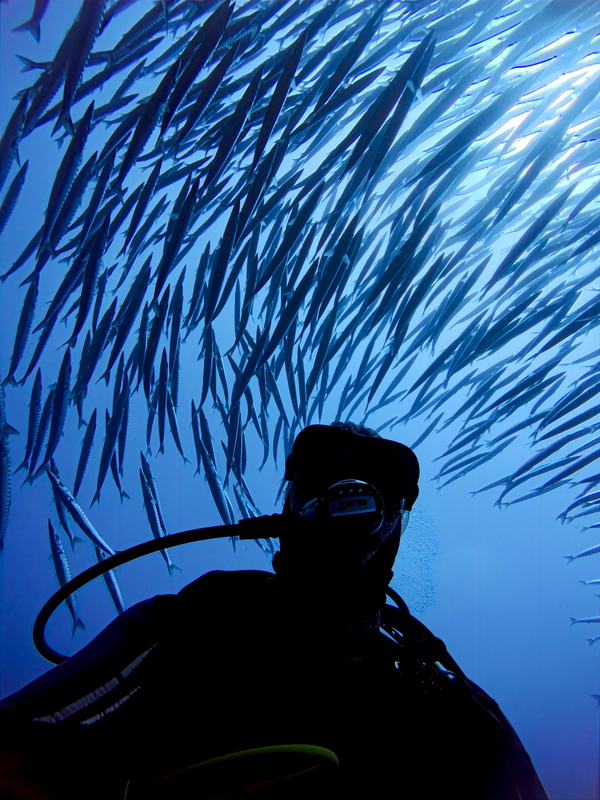
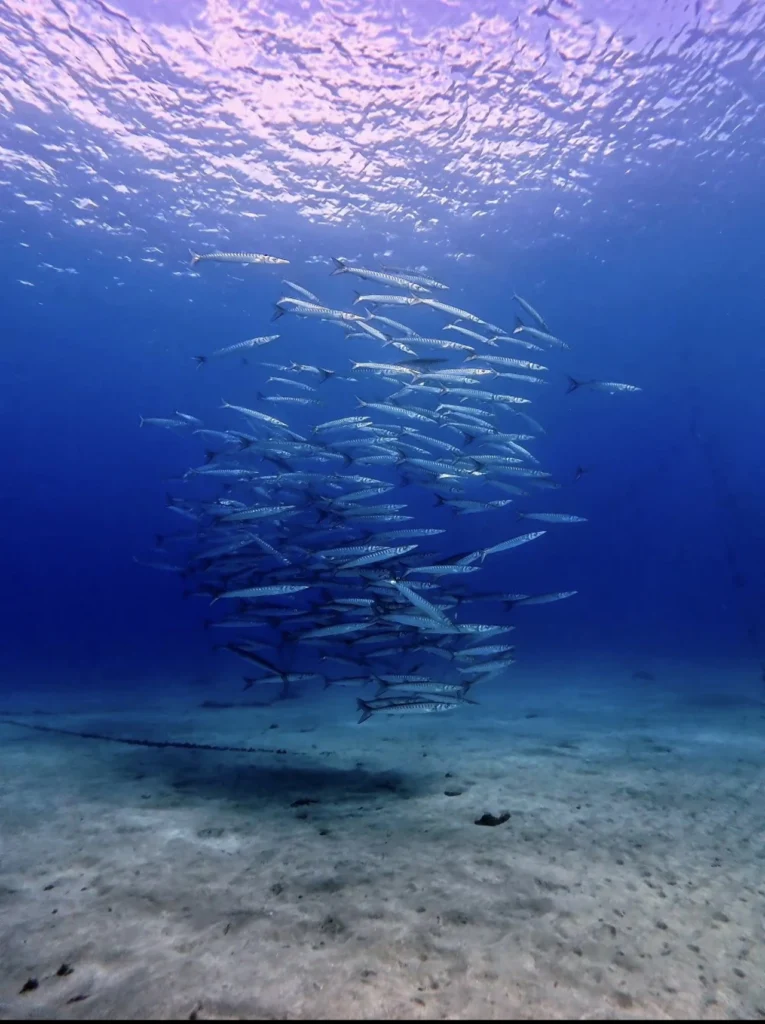
If you’ve ever dived among a school of fish, you’ll know what it feels like: as if the whole ocean came alive in a perfectly synchronized choreography, with hundreds or even thousands of fish moving as one, turning, changing direction, dodging predators and creating impossible shapes in the middle of the blue. Is it magic? No — it’s science, and a lot of collective intelligence.
This mesmerizing spectacle is a common highlight during dives with Barbarian Diving Tenerife, offering one of the most captivating underwater experiences in the Atlantic Ocean.
Table of Contents
What is a school of fish or shoals?
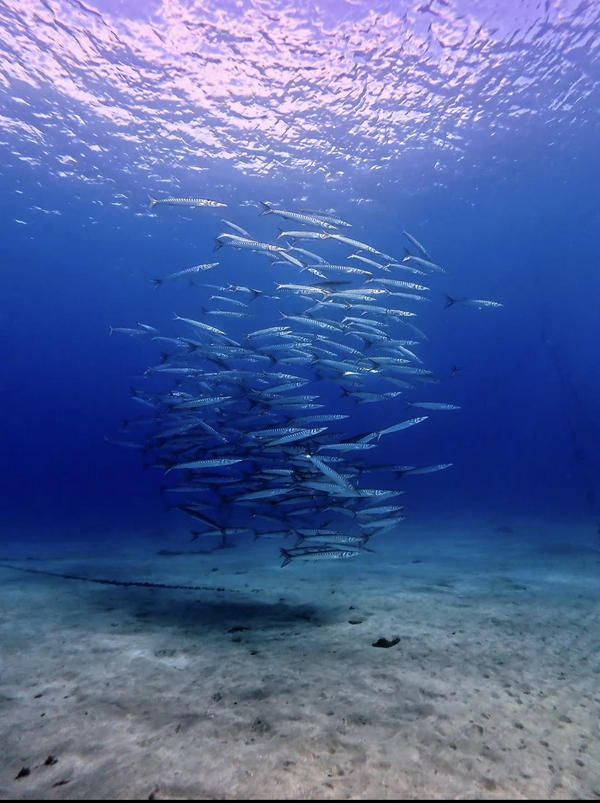
Although we use both terms interchangeably, there’s a slight difference between a “shoal” and a “school of fish”. A shoal is simply a group of fish swimming together in a somewhat disorganized way; when that group moves harmoniously, in perfect synchronization, it becomes a school. What looks at first glance like a simple gathering is actually a highly effective evolutionary strategy — it’s not just about being together, but about communicating, adapting and responding to the environment as a single unit. It’s the closest thing to collective intelligence in the marine world.
Why do fish swim in schools?
There are several reasons why fish form these spectacular groups, and all of them come down to survival.
- Defense against predators: swimming in a group creates a “confusion effect” — it’s much harder for a predator to focus on a single fish when hundreds are moving at once, and being part of the crowd lowers each individual’s odds of being caught.
- Efficiency in movement: moving in a group reduces energy expenditure, since each fish takes advantage of the fish in front of it — much like migratory birds flying in formation. Studies suggest this teamwork can save up to 20% of the energy needed to swim.
- Better access to food: a school can detect food faster and more efficiently, since thousands of eyes searching are far more effective than just one pair.
- Social interaction and reproduction: in some species, such as seabreams, being part of a school makes it easier for males and females to meet during the breeding season. In others, such as dolphins, females form alliances to protect themselves during courtship.
What species form schools in the Canary Islands?
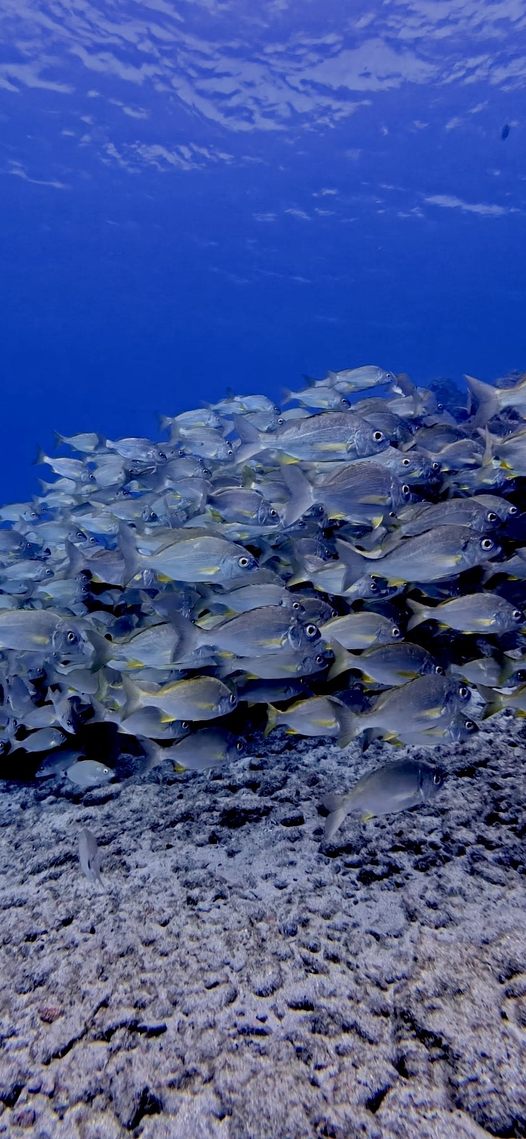
If you dive in the Canary Islands, schools of fish are a common part of the underwater landscape. Frequent species include bogues, which form huge schools that move in unison near the surface, creating impressive flashes of light; saupes, recognizable by their horizontal golden lines and usually found near the bottom in rocky areas and seagrass meadows; barracudas, fast predators that sometimes group together in orderly formations; white trevallies, which are very fast and form dense groups that often attract hunters such as tuna or dolphins; and bastard grunts, which often form schools of up to a thousand fish — groupings so striking they make for spectacular dives whenever they’re sighted.
How do fish communicate within a school?
Although they have no traffic lights, road signs or even a leader, fish in a school communicate through visual signals and water pressure. A sensory structure called the lateral line detects movements in the water around them, letting each fish instantly sense if its neighbor has turned, accelerated or slowed down — and that’s how the whole school stays in perfect sync.
Diving inside schools of fish
Diving surrounded by hundreds of fish moving as one is something you never forget — the light, the sound, the feeling of being enveloped in a “dance of the ocean” is an experience that stays with you. So when you plan your next dive in the Canary Islands, keep your eyes open — you’re likely to witness it yourself. And if you want to make sure you see them, just ask us for our favorite spots at Barbarian Diving. We’ll take you to the heart of the action.
For a more comprehensive list of Tenerife’s premier dive sites, check out our article on the Top 10 Dive Sites in Tenerife